
Madrid presents the Mercamadrid Smart Urban Space to promote the mobility of the future
March 11, 2026
Mercamadrid is establishing itself as an urban laboratory for experimenting with new mobility and energy solutions as part of the European Mobilities for EU project
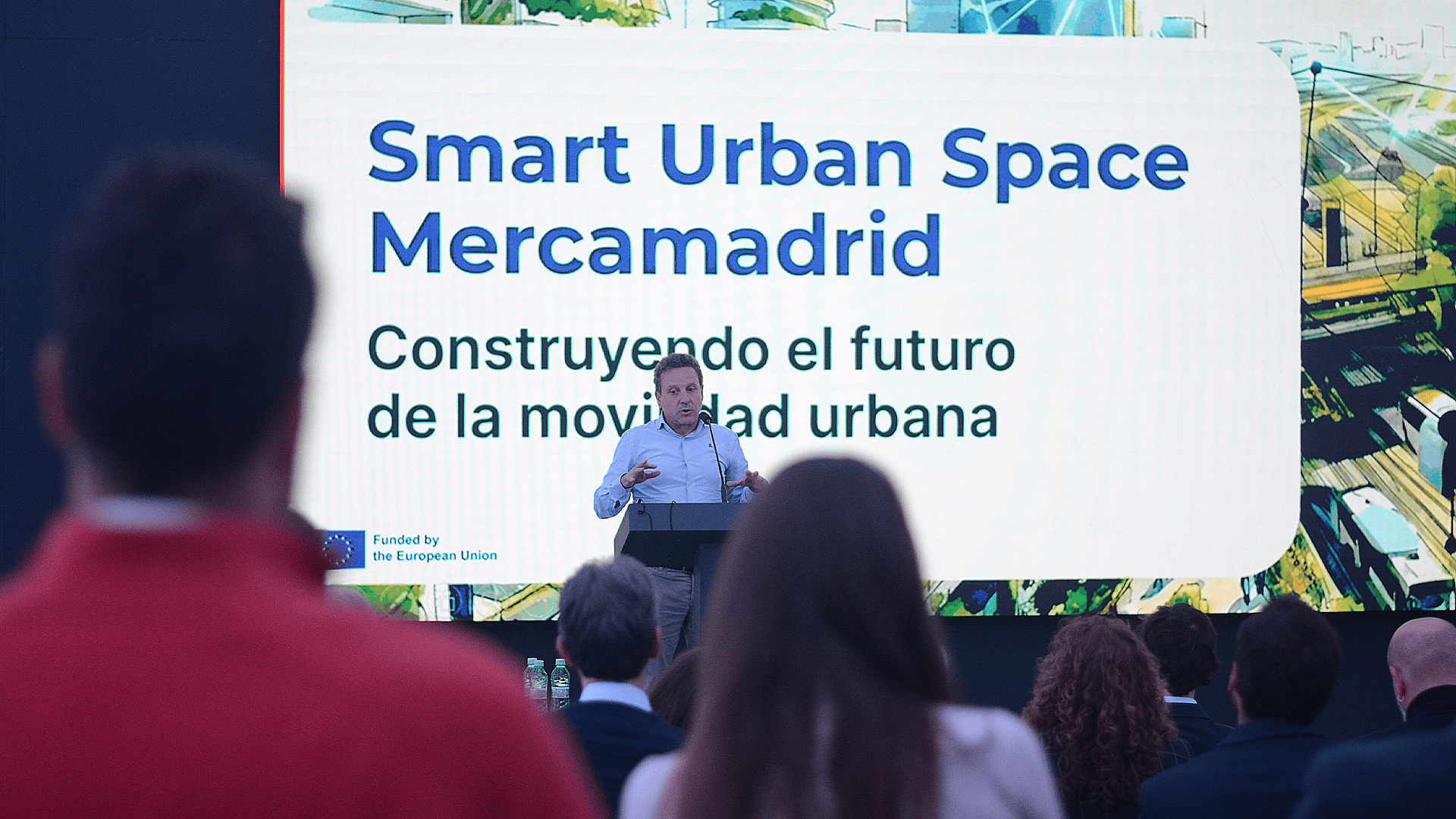
On Wednesday 11 March, the Mercamadrid Smart Urban Space and its first autonomous and connected bus were unveiled, an initiative that forms part of the European Mobilities for EU project and the Madrid Capital Digital municipal strategy. This Smart Urban Space (EUI) is designed as a real-world testing ground for new solutions in connected mobility, smart energy management and urban digitalisation, which will enable the validation of key technologies for the development of more efficient and sustainable cities.
The event brought together representatives from Madrid City Council, technology companies, mobility operators and partners from the urban innovation ecosystem. Among the authorities present was María José Aparicio Sanchiz, General Coordinator of Mobility for Madrid City Council.
The participants highlighted the role of collaboration between administrations, operators and technology companies in developing new urban transport solutions. Among them was Emilio Prous, coordinator of the Madrid Green Urban Mobility Lab, who opened the session by highlighting the importance of this innovation ecosystem in accelerating the implementation of new technologies in the city.
ALSA presented the progress made in the development of the Zero-Emission Autonomous and Connected Bus (CCAM), which attendees were later able to board. For its part, PreZero announced that its autonomous waste collection vehicle will begin operating at Mercamadrid in September 2026.
The connectivity required for this type of solution will be provided by +Orange, whose representatives highlighted the importance of ensuring secure, high-capacity communications for connected vehicles and smart urban systems.
In the energy sector, Ferrovial explained the development of an electrical infrastructure based on energy regeneration and transformation centres, while Plexigrid presented the development of an energy digital twin that will enable scenarios to be simulated, consumption to be optimised and the management of the urban electricity grid to be improved.
T-Systems also presented advances in urban data integration, which currently incorporates 26 sources of information related to mobility, energy and the environment, many of them in real time. This system will improve the synchronisation between energy supply and demand and contribute to reducing CO₂ emissions.
Following the presentations, a practical demonstration was given to the specialist media of the project’s connected autonomous bus, one of the most innovative technologies being tested within the framework of Mobilities for EU. This initiative, led by Madrid together with other European cities, aims to demonstrate how digitalisation, artificial intelligence and connectivity can transform urban services and create new mobility models.
The day concluded with a speech by Fernando Álvarez, representing the Madrid City Council’s Digital Office, who highlighted the role of technology as a fundamental tool for building the city of the future, which will be more sustainable, efficient and people-centred.
This initiative is part of the Digital Transformation Strategy promoted by the Madrid City Council’s Digital Office and forms part of the Collaboration Agreement signed between Madrid City Council and the Polytechnic University of Madrid.
More information about the Madrid, Digital Capital Strategy here.
More information about the Digital Office here.
Related news

Madrid City Council Awarded for its Smart City Project
28 September, 2023 The Madrid City Council has won the “Silver Seoul Smart City” award in the “Technological Innovation Project” category for the project “Madrid Data-Based, City Intelligence”. This award is granted by the World Organization of Sustainable and Smart Cities. Fernando de Pablo, general director of the Digital Office of the Madrid City Council, […]

Madrid: Climate Neutral and Smart Cities Mission
13 October, 2023 The City Council of Madrid has been recognized by the Directorate-General for the Environment of the European Commission for its outstanding climate commitment. The city has reached a crucial milestone by receiving the “Climate City Contract” (CCC), a fundamental step in its participation in the Mission of Climate-Neutral and Smart Cities. This […]
Held the First Workshop on Digital Transformation and Cybersecurity
21 December 2023 The Madrid City Council organized on December 15 the First Workshop on Digital Transformation and Cybersecurity to present the results of the “Madrid, Digital Capital” initiative, aligned with national and international strategies. The event took place in the Pavilion of the Cecilio Rodríguez Gardens in Retiro and was attended by more than […]